



Choosing the right footwear goes far beyond design or size; you also need to know your foot type in order to look after your health and achieve comfort. That's why in the following article you'll discover how to identify the shape, length and morphology of your feet, and why this information is essential if you're considering switching to barefoot or minimalist footwear.
Why is it important to know your foot type?

When we think about buying footwear, we usually focus on the design, the size or the price. But there's a very important aspect we often overlook: our foot type. Knowing your foot type not only helps you choose a more comfortable shoe, it also prevents discomfort, improves posture and avoids long-term injuries.
Imagine walking every day in a shoe that squeezes your toes, doesn't respect the natural shape of your foot or limits its movement. The result is pain, chafing or even problems in your knees, hips and back. That's why, if you're thinking about taking the step towards barefoot or minimalist footwear, identifying what your foot is like is the first thing you should do.
What types of foot are there?
To know your foot type you need to look at three things: its anatomy, its length and its overall morphology. Here's how we explain it:
According to its anatomy (shape of the toes)
- Egyptian foot: the big toe is the longest and the others descend progressively. It's the most common type.
- Greek foot: the second toe is longer than the first.
- Roman or square foot: the first three toes are of a similar length.
According to its length (size and proportion)
In addition to length, it's important to take into account:
- The distance between the heel and the longest toe
- The proportion between length and width
These measurements ensure the foot has enough freedom to move, to support itself naturally and to avoid friction.
According to its morphology (structure and width)
Here we move into a more complete view of the foot, considering its width, plantar arch and overall structure:
- Wide foot: needs generous lasts that allow expansion without pressure.
- Narrow foot: better with models that include fastening systems (such as laces or Velcro).
- Normal, flat or high arch: although barefoot aims to stimulate the arch naturally, knowing its initial shape helps to make a safe transition.
Which is the most common foot type?

The most common foot type among the population is the Egyptian foot, which, as we said, stands out for having the big toe longer than the rest, with the other toes descending progressively. It's estimated that more than half of people in the world, between 50% and 70%, have this foot shape.
The other foot types, the Roman and the Greek, are less common. The Roman foot is present in around 25% of the population, while the Greek is the least frequent.
How to know what your foot type is?
Knowing your foot type is easier than you think. You only need a few minutes and very simple materials. Here's a step by step:
Step 1: Gather the materials
- A sheet of paper (ideally A4 size)
- A pen or pencil
- A ruler or tape measure
- Water or cream (optional, to mark the print)
Step 2: Take the shape of your feet
Place the sheet of paper on the floor, barefoot and in a natural position. If you want more precision, lightly wet the sole of your foot or apply a little cream to mark your print on the paper. Make sure your body weight is well distributed across both feet. Mark the following points with a pencil:
- The heel
- Each of the toes
- The inner and outer edges of the foot
Step 3: Measure and observe
- Foot length: from the heel to the longest toe. Repeat with both feet (there may be differences).
- Shape of the toes: Which one is the longest? Do they all have a similar length? That way you'll know if your foot is Egyptian, Greek or Roman.
- Foot width: measure the widest part, usually in the metatarsal area.
What is barefoot footwear and why does it adapt to all foot types?
Barefoot footwear, also known as minimalist footwear, is an alternative that mimics the sensation of going barefoot, but with the protection you need for everyday life. It's designed to respect the natural shape of the foot, allowing free, healthy and unrestricted movement.
Unlike conventional footwear, which tends to compress the toes, raise the heel or include rigid soles, barefoot opts for an anatomical, functional and flexible design, ideal for walking, training or simply living in greater connection with your body.
We recommend reading our guide: what barefoot is.
What features make it so special?
- Wide toe box: respects the natural shape of the toes, without compressing them.
- Zero drop: the heel and forefoot are at the same height, promoting a more aligned posture.
- Thin and flexible sole: allows a greater perception of the terrain and favours balance.
- Lightness: by reducing unnecessary materials, it feels like a second skin.
Types of barefoot footwear: which one to choose?
A common misconception about barefoot footwear is that they're all the same. And the reality is that barefoot footwear isn't homogeneous: there are varied styles that adapt to different uses and tastes. For example:
Barefoot sneakers
Perfect for everyday life, urban walks or training without giving up comfort or style:
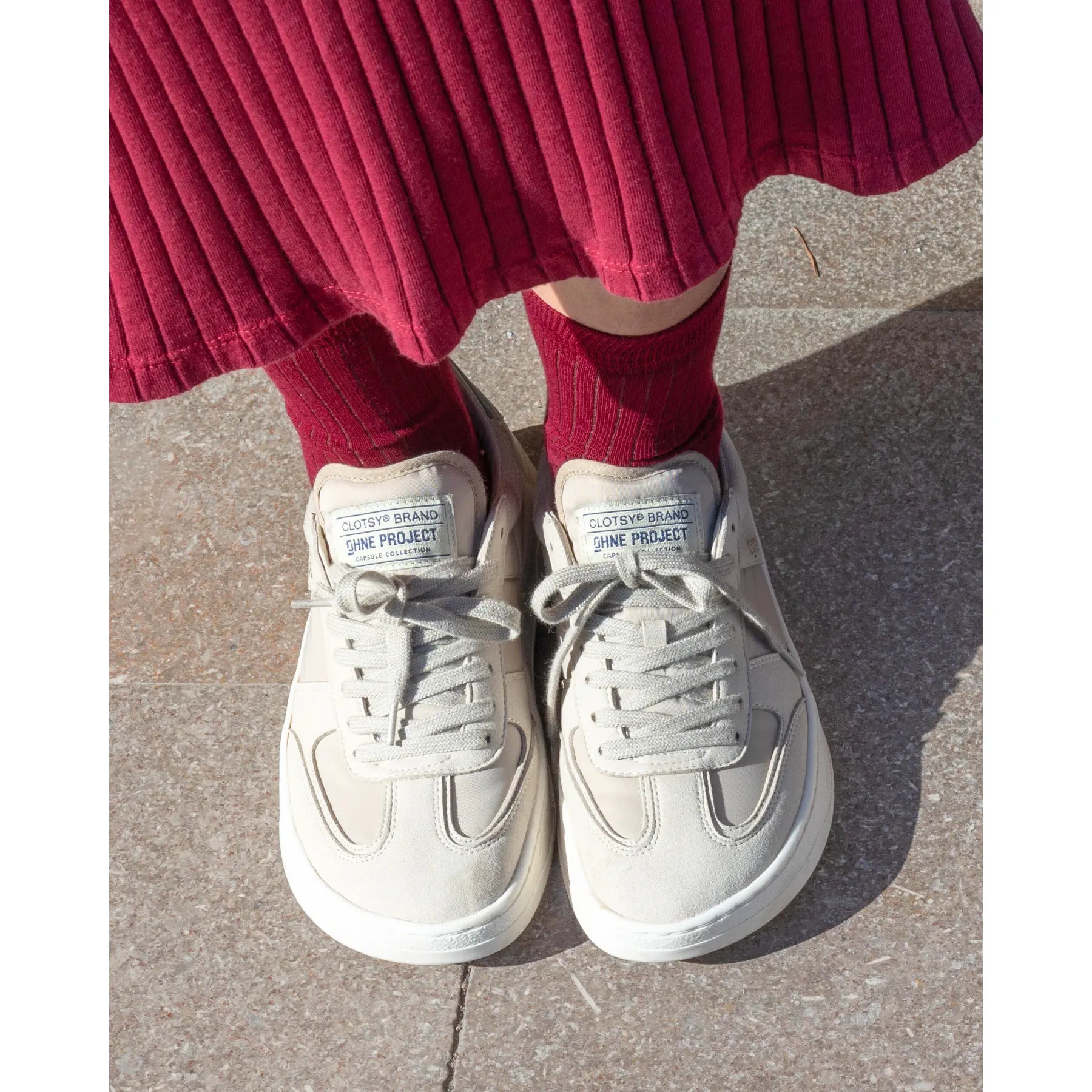
- Barefoot 070 Taupe Sneaker: minimalist design in neutral tones, ultra-thin sole and wide last. Ideal for those looking for comfort and versatility.
- Barefoot 070 Burgundy Sneaker: the same technical base as the taupe model, but in an elegant burgundy colour. It works very well with casual looks.
In addition, our sneakers are ideal to wear with our barefoot socks.
Barefoot sandals
The barefoot sandals are ideal for summer and spring; they're light, open and highly breathable. At Clotsy Brand you'll find the "Sandalias Alba", which are sandals with:
- A spacious toe box, clipped in barefoot style.
- Adjustable straps for wide or narrow feet.
- A thin sole that allows a feeling of freedom without losing protection.
- Perfect for those looking for summer comfort with an eco-friendly style.
Ballerinas / barefoot flat shoes
Our barefoot ballerinas, elegant while still being comfortable. The "Bailarinas Aurora" in burgundy, mocha or navy tones were designed for a feminine and sophisticated look, with a wide last and flexible sole.
How to know which barefoot shoes to buy?

Choosing your first pair of barefoot shoes surely seems like a challenge, but if you know what to look at, it's very easy to find the perfect model for you. Remember: this type of footwear should adapt to your foot, not the other way around. So, when you're buying your barefoot footwear, remember the following:
Get to know your foot type well
Before buying any barefoot footwear, identify whether you have a foot that is:
- Egyptian, Greek or Roman, according to the shape of your toes.
- Wide or narrow, by measuring the outline and noticing whether your conventional shoes squeeze you.
- With a high, medium or flat arch, to know what level of cushioning you need.
Choose the type of barefoot footwear according to your lifestyle
Depending on your routine, you'll need a more robust or a lighter model:
- For everyday use or walking around the city, sneakers are better.
- For summer or warm climates, sandals.
- For office or elegant looks, ballerinas.
Try, walk and feel
When you put on a barefoot shoe:
- Your toes should be able to move freely.
- The sole should let you feel the ground without discomfort.
- There shouldn't be any pressure or friction points.
Know your foot type and choose the barefoot footwear that adapts best to you
Every foot is unique and its shape directly influences your posture, comfort and health when walking. Identifying your foot type not only helps you understand your body better, but also helps you choose the ideal footwear for you. At Clotsy Brand, the sustainable clothing store, we believe that you shouldn't adapt to the shoe, but rather the shoe should adapt to you!
That's why we're committed to barefoot: minimalist footwear, with a flexible sole and an anatomical shape that respects the natural structure of your foot. Designed to offer freedom, balance and well-being with every step, our barefoot shoes are made with recycled and sustainable materials, in processes that look after the planet.
Walking is also a form of expression: choose to move with respect, safety and comfort, by choosing Clotsy Brand.
Conclusion
In conclusion, understanding your foot type lets you choose barefoot footwear that truly respects your anatomy, improves your posture and accompanies you comfortably with every step. Whether you have an Egyptian, Greek or Roman foot; wide or narrow; with a flat or high arch, there's an ideal model for you. Barefoot not only adapts to all these variations, but also promotes a free stride.
Leave a comment